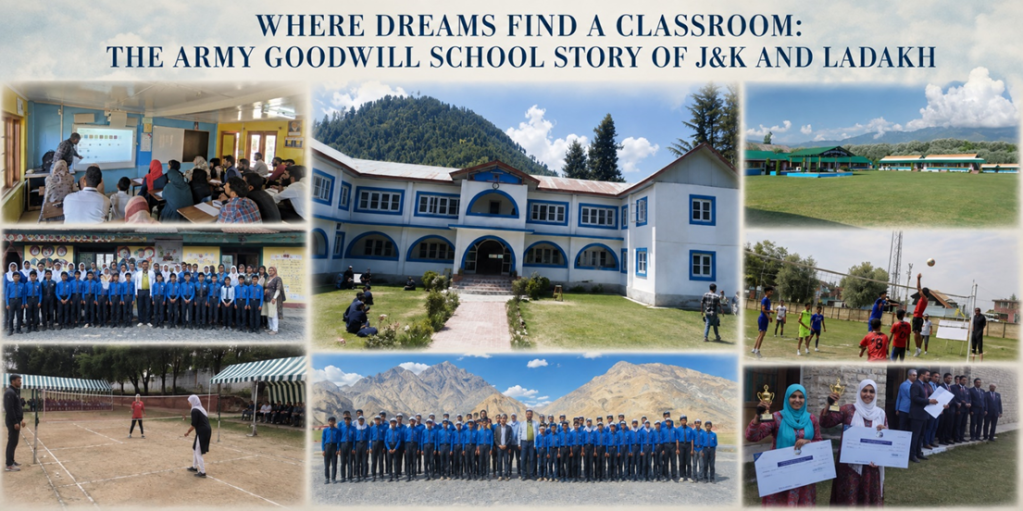
Every dream needs a place to start. It might be as simple as walking through the gates of a school for a child growing up in a remote village of Jammu and Kashmir or in the high-altitude landscapes of Ladakh. Even though the surroundings may be defined by mountains, difficult terrain and long distances from major educational institutions, a child’s aspirations need not be confined by them. More than two decades ago, Army Goodwill Schools sought to create such elevated vantage locations of opportunity across J&K and Ladakh. What began as a movement aiming to open up access to education in remote and border areas has been growing into a wider educational ecosystem around learning, skills, exposure and opportunities for the future.
A significant component of the story is the size of that network. According to the official network of the Army Goodwill Schools, 43 schools have been established across the Union Territories, including 28 in the Kashmir division as well as eight in Jammu and seven in Ladakh. Around 17,000 students are now being taught in these schools, with girls making up about 43 per cent of the student population. The network also counts about 1,000 staff members among its ranks. These numbers matter but they matter more for the geography behind them. However, a school in a remote or border area does far more than just provide regular education. It brings a structured learning environment closer to communities where access to wider educational opportunities can be more difficult.
Education itself is also changing in meaning. The question now is not just whether a child can go to school but whether that child can get an education that is relevant to a fast-changing world. Army Goodwill Schools’ focus areas now include smart classrooms, specialised coaching, career counselling, digital learning, artificial intelligence and robotics along with NEP aligned learning and teacher training. The idea is to give students a stronger grounding while exposing them to new kinds of knowledge and emerging career paths. This is a big change because students today will enter a world where technology, flexibility and continuing education will be as important as traditional academic credentials.
But no two students come to the educational process under the same circumstances, and the quality of an educational system is often judged by the breadth of possibilities that it reveals. For one student, success might be going to medical school or engineering school. For another, it might mean pursuing science, taking up the civil services, becoming an entrepreneur, excelling in sport or building a career in technology. Some may find their strengths in academic contests, others in cultural activities, sports or practical learning. What’s important is that education cannot prescribe one definition of achievement. It should give students sufficient exposure to find out where their own abilities and interests may lead them. That is where the concept of feeding dreams becomes more important than just taking note of the results.
The J&K and Ladakh landscape also demonstrates why location continues to be an important part of the educational conversation. Schools in the Kashmir valley, close to the Line of Control, and at high-altitude terrain in Ladakh work in very different physical environments. But the educational aspiration is strikingly similar: students want access to good teachers, modern learning, opportunities and a chance to compete beyond their immediate surroundings. Today the network comprises seven Army Goodwill Schools in Ladakh for the benefit of students at Bogdang, Dras, Faroona Kargil, Harka Bahadur, Karu, Partapur and Tyakshi. These schools and educational exposure initiatives also help reach children in remote parts of the Union Territory, government sources have said.
Sometimes exposure is as important as instruction. When students visit universities, research institutions or other educational centers, places that may have existed previously only as names in textbooks become tangible possibilities. AGS hosted an educational exposure program for IIT Jammu, in April 2026. The two-day residential program was attended by 67 students and 17 principals and teachers from 20 schools. Another 2026 initiative was students visiting CSIR-IIIM, Srinagar where they visited laboratories, interacted with scientists and got introduced to research and career possibilities in science. These experiences can broaden a student’s mental map. A university lab is no longer an abstraction; it is a place a student can envision walking into one day.
So the story of Army Goodwill Schools is ultimately bigger than a network of institutions. It is about the slow expansion of what is possible for children in J&K and Ladakh to see. A school can give a textbook but it can give a question too. A laboratory can give you equipment, but it can also give you curiosity. A competition can give a certificate but it can also display an ability. A career counsellor can provide information, but also help a student see a path that was not visible before. It is often in these subtle changes of perception that long-term educational change begins.
Sometimes the most outstanding achievement of a school may not be the student who wins the biggest award or the highest marks. It could be the generation that grows up with a more expansive sense of what education can offer and a greater ability to make informed choices about its future. From the valleys of Kashmir, the mountains of Jammu and the high altitude communities of Ladakh, Army Goodwill Schools are trying to make that possibility a part of everyday education. The dream may begin with a child and a classroom, but the destination may be much larger. When education gives young minds space to imagine more, a school does more than teach the present; it helps to shape the future.

 Kashmir RootStock