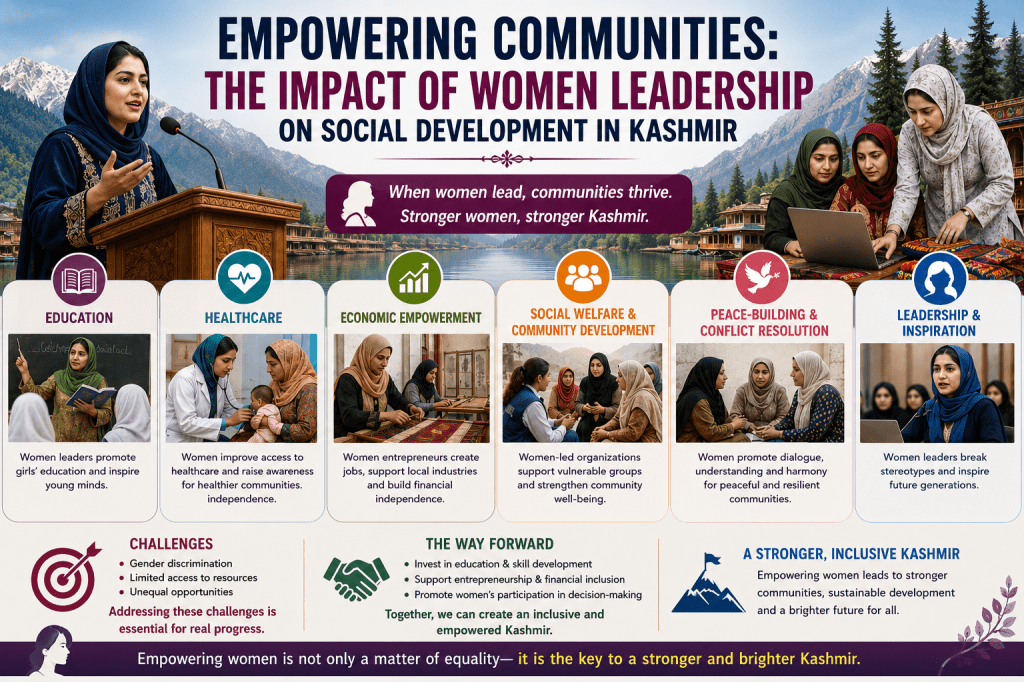
Women have always been the backbone of Kashmiri society. Whether in rural villages, urban centers, educational institutions, healthcare facilities or local businesses, women have played a significant role in shaping the social and cultural fabric of the region. In recent decades, however, their role has expanded beyond traditional responsibilities, with an increasing number of women assuming leadership positions and contributing directly to social development. Despite facing social, economic and cultural challenges, women leaders in Kashmir have emerged as powerful agents of change, influencing education, healthcare, economic growth, community welfare and peace-building initiatives.
The concept of leadership is no longer confined to political offices or corporate boardrooms. Today, leadership is demonstrated through the ability to inspire, organize and create positive change within communities. Across Kashmir, women are leading educational campaigns, managing businesses, advocating for social justice, promoting healthcare awareness and supporting vulnerable populations. Their efforts have significantly contributed to the region’s development and have transformed the lives of countless individuals.
One of the most notable areas where women’s leadership has made a difference is education. Historically, many girls in remote areas faced barriers to education due to economic constraints, social norms and limited access to schools. Women educators, activists and community leaders have worked tirelessly to address these challenges. Through awareness programs and advocacy efforts, they have encouraged families to prioritize the education of girls. As a result, female literacy rates have improved and more young women are pursuing higher education than ever before. Educated women not only improve their own lives but also contribute to the well-being of their families and communities.
Women leaders have also played a critical role in healthcare development. Access to healthcare remains a challenge in many parts of Kashmir, particularly in remote and mountainous regions. Female doctors, nurses, social workers and healthcare advocates have been instrumental in raising awareness about maternal health, child nutrition, mental health and preventive healthcare. Their outreach efforts have helped reduce health-related risks and improve access to essential services. During times of crisis and public health emergencies, women healthcare professionals have often been at the forefront, providing care and support to affected communities.
Economic empowerment represents another significant contribution of women’s leadership. Across Kashmir, women entrepreneurs are breaking barriers and creating opportunities for themselves and others. From traditional handicrafts and handloom industries to modern technology-based enterprises, women-led businesses are contributing to economic growth and employment generation. These entrepreneurs have demonstrated that financial independence can serve as a catalyst for broader social change. By providing employment opportunities, supporting local industries and encouraging innovation, women business leaders are strengthening the economic foundations of their communities.
Self-help groups and cooperative societies led by women have become important tools for economic development. These organizations enable women to access financial resources, develop new skills and build sustainable livelihoods. Through collective action, women are addressing economic challenges and creating support networks that enhance community resilience. Such initiatives have proven particularly valuable in rural areas, where employment opportunities are often limited.
Beyond education and economic development, women leaders have made significant contributions to social welfare and community development. Numerous women-led organizations work to support marginalized groups, including widows, orphans, persons with disabilities and economically disadvantaged families. These organizations provide essential services such as vocational training, educational support, counseling and humanitarian assistance. Their work strengthens social cohesion and helps ensure that vulnerable populations are not left behind.
Women have also emerged as important voices in peace-building and conflict resolution. Kashmir has experienced decades of political uncertainty and social challenges, making community resilience and social harmony essential priorities. Women leaders often bring unique perspectives to peace-building efforts, emphasizing dialogue, empathy and community engagement. Through grassroots initiatives, they have facilitated discussions, promoted understanding among diverse groups and encouraged collaborative solutions to local challenges.
The growing participation of women in public life has also challenged traditional gender stereotypes. Successful female leaders serve as role models for younger generations, demonstrating that women can excel in various fields while contributing meaningfully to society. Their achievements inspire confidence among young girls and encourage greater participation in education, leadership and professional careers. Despite these positive developments, significant challenges remain. Gender discrimination, unequal access to resources, limited representation in decision-making positions and societal expectations continue to restrict opportunities for many women. Rural women, in particular, often face additional obstacles related to mobility, financial access and educational opportunities. Addressing these challenges requires comprehensive policies, institutional support and continued efforts to promote gender equality.
Government institutions, civil society organizations and community leaders all have a role to play in supporting women’s leadership. Investments in education, skill development, entrepreneurship programs and leadership training can help create an environment where women can thrive. Furthermore, increasing women’s representation in political and administrative institutions can ensure that their perspectives are included in decision-making processes.
The future development of Kashmir depends on the active participation of all members of society. Women’s leadership has already demonstrated its transformative potential by improving education, strengthening healthcare systems, promoting economic growth and fostering social cohesion. As more women assume leadership roles, their contributions will continue to shape a more inclusive, prosperous and resilient Kashmir.
In conclusion, women leaders are not merely participants in Kashmir’s development journey; they are among its most influential architects. Their dedication, resilience and vision have empowered communities, improved lives, and inspired future generations. By recognizing and supporting women’s leadership, Kashmir can unlock even greater opportunities for social progress and sustainable development. Empowering women is not only a matter of equality—it is a fundamental requirement for building stronger communities and a brighter future for all.


