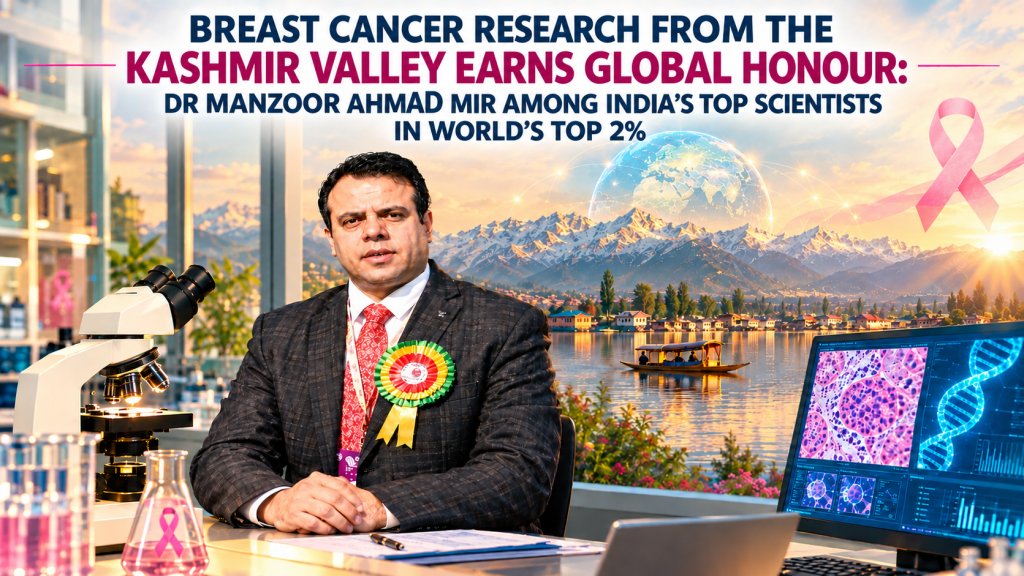
Dr Manzoor Ahmad Mir of the Department of Bioresources, University of Kashmir, has once again earned a place among the world’s top 2 per cent scientists. He features in the Stanford University-linked ranking, prepared with data from Elsevier, for the fourth year in a row, in 2023, 2024, 2025 and 2026, under the Health Sciences category. The recognition draws attention to a researcher whose breast cancer work, carried out in the Valley, is read and cited across the world.
Dr Mir’s research focuses on breast cancer, with particular attention to drug resistance and new treatment paths. Resistance to therapy is among the hardest challenges in cancer care, because tumours that first respond to medicines can later stop responding. Studies that explain why this happens and open alternative routes to treatment are central to modern oncology, and his work sits squarely in this area.
His record shows sustained effort. He has authored more than 100 research papers, which have gathered over 4,900 citations in the last five years. In the ranking database, his main field is listed as Clinical Medicine and his sub-field as Oncology and Carcinogenesis, where he holds a global rank of 1,106. His h-index stands at 19. For a scientist working far from the country’s largest research hubs, such consistency reflects both quality and persistence.
Dr Mir’s contribution goes beyond publications. He has guided doctoral students, helping train the next generation of researchers in the region. He also serves as an Adjunct Professor at the Indian Institute of Sustainability (IIS), Gujarat University, Ahmedabad, a role that links his work in Kashmir with institutions elsewhere in the country and encourages the exchange of ideas across academic communities.
Equally important is his effort to take science back to the people. Dr Mir runs breast cancer awareness activities in the Valley, reaching out to communities where timely information can make a real difference. Awareness and early detection remain among the most effective tools against the disease, and his outreach ensures that the benefits of research are not confined to journals and conferences.
His achievement also carries a wider message. Appearing in the top 2 per cent list four years running is no one-time distinction. It points to steady, high-quality work over several years. It shows that world-class science can be pursued from Kashmir and that researchers here can stand alongside the best in the world.
For the young students and scholars of the Valley, Dr Mir’s journey offers a clear example. Dedication to a meaningful problem, patience in the face of difficulty and a commitment to serve society can together produce work that earns global recognition while still benefiting people at home.


